
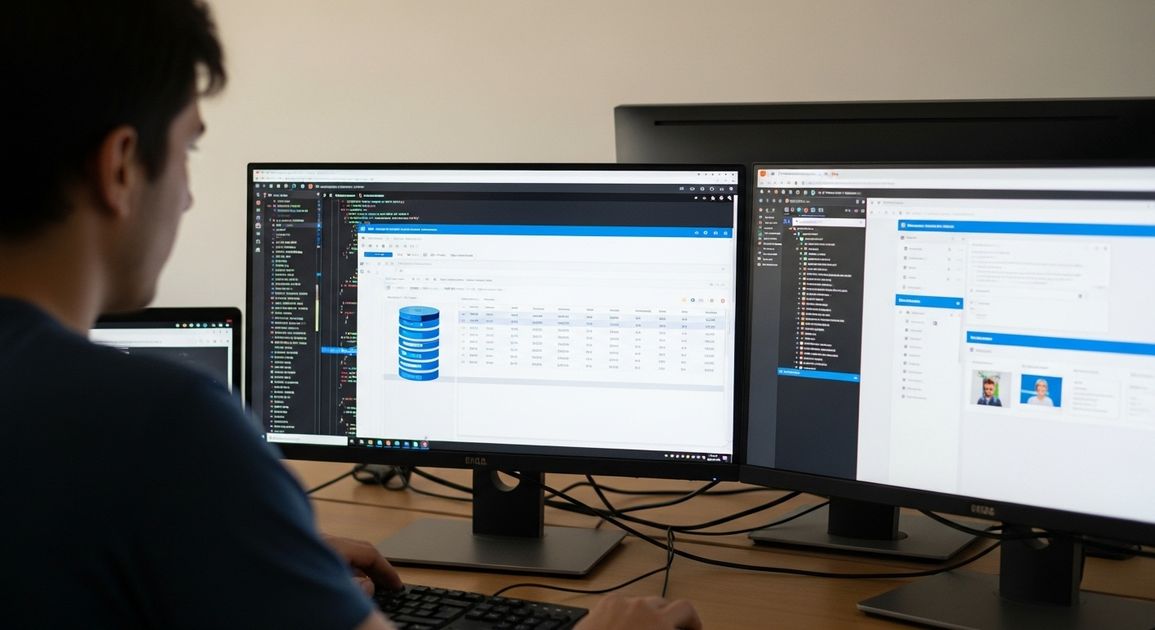
Some development companies specialise in building beautiful interfaces but need to hire other teams to handle the database and business logic. Others focus on backend systems and data architecture but bring in frontend specialists for the user interface. This split approach creates coordination overhead and increases the chance that pieces won't fit together properly.
Full stack development means one team handles the entire application from how data gets stored and processed through to what users see and interact with. We design the database schema, build the business logic that processes information, create APIs that connect everything together and develop the interface people actually use. Everything gets built by people who understand how all the pieces work together because they're building all the pieces.
What the stack actually includes
The database layer stores your business data and handles queries efficiently. This means choosing appropriate database technology for your data structure and access patterns, designing schemas that support your application's needs and setting up proper indexing so queries run quickly even as data volumes grow.
Backend services implement your business logic and handle operations that shouldn't happen in users' browsers. Calculating complex pricing based on multiple variables, processing payments securely, generating reports from large datasets, sending notifications when specific conditions occur. This layer enforces business rules and manages operations that require server resources or need to stay secure.
APIs connect the frontend and backend, defining how data flows between what users see and what happens on servers. Well-designed APIs make applications faster and more reliable by transferring only necessary data and handling errors gracefully when network conditions vary.
The frontend presents information to users and captures their input. This includes designing interfaces that make sense to people doing their actual work, implementing interactions that feel smooth and responsive and ensuring everything works properly across different devices and browsers.
Why having one team matters
Design decisions at each layer affect possibilities at other layers. How you structure your database influences what queries run efficiently, which affects how quickly the interface can display information. What business logic lives in the backend versus the frontend determines how the application performs and how much works offline.
When one team understands the entire stack, these decisions get made with full context. We know what's technically feasible at each layer and can make intelligent tradeoffs. A feature that seems simple from the interface perspective might require complex database queries. Understanding both sides means finding solutions that deliver good user experience whilst maintaining reasonable performance.
Communication overhead disappears when one team builds everything. There's no coordination needed between separate frontend and backend teams about API contracts or data formats. No delays whilst the database team modifies schemas to support new features the interface team wants to add. The entire application evolves cohesively.
How we approach full stack development
Projects begin with understanding what the application needs to do and how data flows through the system. This shapes decisions about database structure and API design before we write any code. Getting the foundation right makes everything built on top of it easier and more maintainable.
We design databases for the queries your application will actually run. An application showing customer order history needs different indexing than one tracking real-time inventory across warehouses. The database structure reflects how your business uses the data, not abstract ideals about how data should be organised.
Business logic gets implemented where it makes most sense technically. Validation that prevents invalid data entry can happen in the interface for immediate user feedback. Complex calculations that require significant processing power belong on servers. Security-critical operations always happen server-side where users can't modify or bypass them.
Interfaces get built with realistic data and actual user workflows in mind. We don't create pixel-perfect designs in isolation and then figure out how to make them work with real data. We build interfaces that handle your actual data structure and support how people genuinely work, which sometimes means adjusting initial design concepts when reality doesn't match assumptions.
Technical decisions across the stack
Database choices depend on your data characteristics and scaling requirements. Relational databases work well for structured business data with complex relationships. Document databases suit applications where data structure varies significantly. We choose technology appropriate to your actual requirements rather than defaulting to whatever's currently fashionable.
Backend frameworks provide structure for implementing business logic reliably. We use proven frameworks with active communities and good documentation. This ensures your application gets built on stable foundations that will remain supported and maintainable long-term.
Frontend technology affects how responsive and maintainable your interface becomes. We typically use React for business applications because it provides the right tools for building complex interactive interfaces that stay performant. The component architecture scales well as applications grow and new features get added.
API design determines how efficiently data flows between layers. Well-designed APIs minimise unnecessary data transfer, handle errors gracefully and support the operations your application actually needs. Poor API design creates performance problems and makes adding features more difficult than it should be.
Building for performance across layers
Performance optimisation happens at every layer with different techniques appropriate to each. Database performance comes from proper indexing and efficient query design. Backend performance involves caching frequently accessed data and processing operations efficiently. Frontend performance means minimising unnecessary updates and loading resources effectively.
Understanding the full stack lets us identify where performance problems actually originate. An interface that feels slow might be waiting for backend responses that are slow because database queries aren't optimised. Fixing this requires understanding all three layers well enough to diagnose the actual bottleneck.
We build applications that perform well under realistic conditions from the start rather than trying to optimise poorly designed systems later. This means load testing with data volumes and user counts similar to what you'll actually experience and ensuring queries remain fast as databases grow.
Security throughout the stack
Security requires coordinated implementation across every layer. User authentication happens at the frontend but gets verified server-side. Data validation occurs in the interface for user feedback but must be enforced in the backend because frontend code can be bypassed. Sensitive data gets encrypted in the database and transmitted securely between layers.
Full stack development means security gets considered as part of building features rather than added afterwards. Input validation, authentication, authorisation and data protection all get implemented properly from the beginning because the entire team understands security requirements across the complete application.
Integration with existing systems
Most business applications need to connect with your existing infrastructure. Your CRM, accounting software, inventory systems and other tools each have their own database and logic. New applications need to exchange data with these whilst maintaining their own database for information specific to new functionality.
We build integration layers that connect your new application with existing systems through APIs. Data flows between systems automatically with proper error handling and logging so you can monitor what's happening. The integration architecture ensures data stays synchronised without requiring manual transfer between systems.
Understanding the full stack means we can design these integrations sensibly. We know what data should live in which system, how to handle conflicts when information exists in multiple places and how to structure APIs that make integration straightforward rather than fragile.
Maintenance and evolution
Applications change over time as your business evolves and new requirements emerge. Full stack development means the team that built your application understands every part of it and can modify any layer needed to support new features.
Adding functionality sometimes requires changes at multiple layers. A new reporting feature might need new database queries, additional backend logic to process and format data and interface components to display results. One team handles all of this cohesively without coordination overhead between specialists.
Technical debt gets managed better when one team sees the entire codebase. We can refactor database structures, update backend logic and modify interfaces as needed whilst understanding how changes propagate through the system. The application remains maintainable as it grows.
What you get with full stack development
Single point of contact throughout development means clearer communication and faster decisions. You're talking with the people who actually understand every aspect of your application because they've built every aspect.
Cohesive architecture where all layers work together efficiently rather than being separately optimised pieces that don't quite fit. Design decisions consider the entire application so you get better overall performance and more maintainable code.
Faster development because there's no coordination overhead between separate teams. Changes happen more quickly when one team handles everything from database modifications through to interface updates.
More cost-effective development in many cases because you're paying one team to build everything rather than multiple specialists who need time coordinating with each other. The efficiency gains from cohesive development often outweigh the benefits of highly specialised separate teams.
When full stack development makes sense
Applications where user experience depends heavily on backend performance benefit from having one team optimise the entire flow. Product configurators that need to calculate pricing instantly, booking systems showing real-time availability, dashboards displaying live data. These applications need careful coordination between layers that's easier when one team builds everything.
Projects with tight timelines benefit from the efficiency of full stack development. Eliminating coordination overhead between separate teams means features get built and deployed faster. When you need working software quickly, having one team handle everything accelerates delivery.
Businesses wanting long-term maintainability prefer full stack development because the team that built your application can maintain and extend it efficiently. There's no knowledge split between frontend specialists who don't understand the backend and backend developers who don't touch the interface.
Our full stack capabilities
We've built complete applications from database design through to polished user interfaces for businesses across various sectors. Our experience includes product configurators handling complex business rules, scheduling systems managing multiple constraints, booking platforms processing payments and interactive tools engaging customers.
The team understands modern development practices across the entire stack. We write maintainable code, implement proper testing, follow security best practices and build applications that perform well under realistic conditions.
If you're planning a web application and wondering whether full stack development makes sense for your project, we can discuss your specific requirements and explain how having one team handle everything might benefit your particular situation. Sometimes specialised teams make sense. Often, full stack development delivers better results more efficiently.