
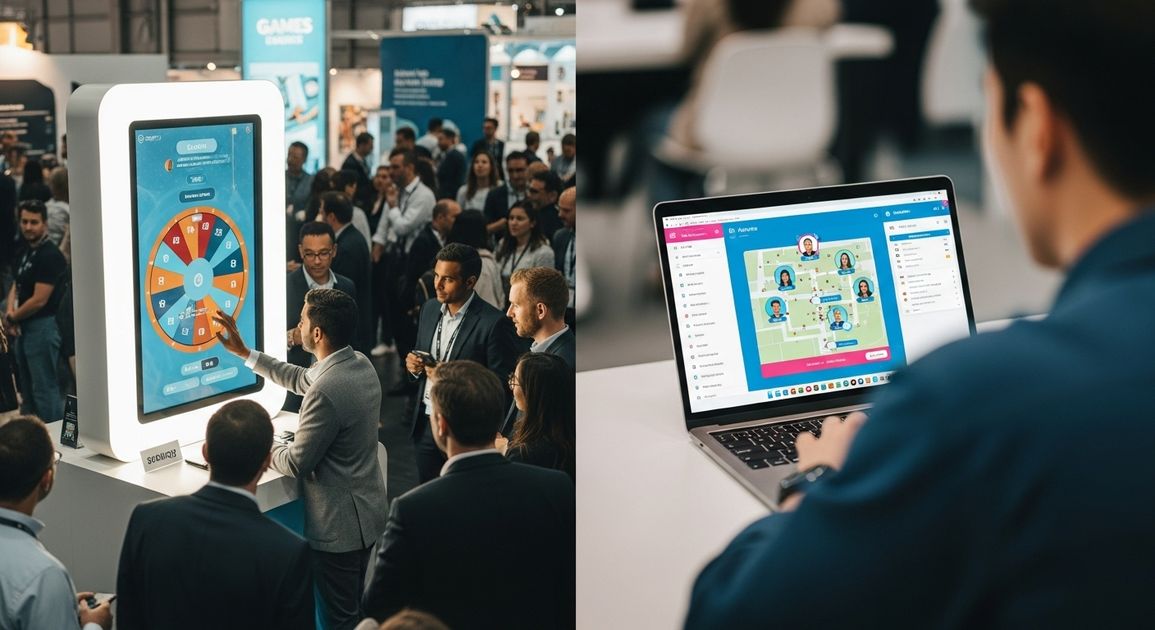
Event marketers face similar problems at physical and virtual events when trying to get attention, maintain engagement, and capture quality leads. Games address these challenges in both contexts but through different mechanisms.
Trade show booths compete with hundreds of others whilst virtual conferences battle screen fatigue and distraction. Games create active engagement that breaks through in both environments.
Physical Trade Shows and Standing Out
Exhibition halls are crowded and attendees walk past quickly with most booths getting ignored. You need something that makes people stop.
Movement attracts attention because a game being played creates visible activity. People notice others engaged and wonder what's happening. Curiosity brings them closer.
Games provide legitimate reasons to approach your booth. Attendees feel awkward walking up to talk yet feel comfortable walking up to play. The game removes social friction.
Playing takes time so someone engaged with a game stays in your booth area for minutes. Your team can observe and identify genuine prospects whilst they play.
Trade Show Game Types
Leaderboard competitions work brilliantly when you display current top scores prominently and update in real-time. People want to see where they rank and return multiple times to check standings.
Product knowledge quizzes educate whilst entertaining through questions about industry challenges your product solves. Players learn about your offering through gameplay.
Spin-to-win mechanics drive immediate conversations. Play the game, win a discount or prize, then redeem by talking to sales team. The game creates natural lead qualification opportunity.
Skill challenges create buzz around something visibly difficult. People gather to watch attempts and the crowd draws more people. The visibility compounds.
Physical Event Lead Capture
Games make lead capture feel natural. To enter competition, provide contact details. To receive results, share email address. The exchange feels fair.
Gameplay behaviour qualifies leads since someone spending ten minutes trying to achieve high score shows genuine interest whilst someone playing once casually shows mild curiosity.
Competition mechanics encourage complete information. Want to win the prize? Need to provide real details. Fake information disqualifies entries.
Follow-up references gameplay by mentioning their score in outreach and referencing which challenges they attempted. The personalisation improves response rates.
Virtual Conference Challenges
Online attention spans are short and attendees multitask. They check email during sessions and leave between talks. Keeping them engaged is difficult.
Passive watching induces fatigue. Hours of presentations exhaust people and they disengage mentally whilst appearing present. The camera stays on but attention drifts.
Networking online feels awkward when people join breakout rooms and stare silently. The lack of natural conversation starters creates uncomfortable pauses.
Drop-off happens predictably as attendance falls throughout the day. Each break loses people so by afternoon, half the morning attendees have left.
Virtual Conference Game Applications
Pre-event games build anticipation when you launch a competition a week before the conference. Top scorers get recognition during opening and this drives early engagement and registration completion.
Break-time games maintain presence by scheduling games during breaks between sessions. Give people reasons to stay logged in since the entertainment prevents abandonment.
Networking games facilitate connections by assigning teams randomly for collaborative challenges. Force strangers to interact around shared objectives since the task removes awkwardness.
Post-session quizzes reinforce learning by testing knowledge from presentations just delivered. Reward high scorers with prizes since the incentive improves attention during sessions.
Virtual Event Game Types
Trivia competitions about conference content use questions based on speaker presentations. Players must pay attention to succeed and the competitive element maintains focus.
Scavenger hunts across the platform encourage finding specific information in exhibition halls, visiting sponsor booths, and engaging with content. The hunt drives exploration.
Prediction markets on session topics let people bet virtual currency on outcomes discussed in presentations. This adds stake to passive watching and creates investment in content.
Social challenges requiring interaction complete tasks that need talking to other attendees. This forces networking and provides conversation starters.
Technical Implementation for Each Context
Physical events need visible displays with large touchscreens mounted prominently. The visibility is crucial since tablets on tables get ignored.
Rugged hardware withstands trade show environments because consumer devices break quickly. Invest in exhibition-rated equipment since the durability matters over multi-day events.
Reliable offline functionality prevents disaster because conference centre wifi fails regularly. Games must work without connectivity by caching everything locally.
Virtual platforms need seamless integration with games accessible directly through conference software. No leaving to external sites since friction kills participation.
Browser-based games work universally without downloads or installations. Click and play immediately because any barrier loses participants.
Measuring Event Game Success
Count booth visitors for physical events to see how many people stopped and how many played. Compare to previous events without games since the increase shows effectiveness.
Track engagement duration to see how long people stay at your booth. Longer dwell time correlates with better lead quality and more sales conversations.
Monitor lead volume and quality to determine whether games increased total leads captured and whether lead-to-opportunity conversion improved. The commercial impact matters most.
For virtual events, watch attention metrics to see whether participants stay logged in longer and whether fewer people drop off during breaks. Check whether post-event survey feedback mentions engagement.
Measure content retention by testing knowledge before and after event. See whether game-enhanced sessions show better information retention than standard presentations.
Common Implementation Mistakes
Choosing overly complex games loses participants because event attendees have limited patience. The game must be immediately understandable since long tutorials kill engagement.
Neglecting staff training creates confusion. Booth staff need to know how games work, must handle technical issues, and should encourage participation appropriately.
Poor placement wastes investment because games hidden in booth corners get missed. Prominent placement in high-traffic areas maximises visibility.
Technical failures destroy credibility so test everything thoroughly before the event and have backup plans. One crash creates negative impression that persists.
Forgetting about accessibility excludes participants. Some attendees have disabilities so games must accommodate different abilities. Universal design expands reach.
Integration with Event Strategy
Games should reinforce event goals. If the goal is lead generation, design for lead capture. If networking matters, create social games. Align mechanics with objectives.
Promote games before events by telling registered attendees about competitions. Create anticipation since early awareness drives participation.
Connect games to sponsor value since sponsors pay for visibility. Game mechanics can highlight sponsors naturally and this creates additional revenue opportunities.
Use game data in follow-up by referencing participation in post-event communications. The shared experience creates connection and improves response.
Budget Considerations
Physical event games need equipment rental or purchase since touchscreens cost money. Factor in shipping and setup labour.
Game development is one-time investment and the asset works across multiple events. Per-event cost drops significantly after first use.
Virtual event games integrate with platform costs. Some platforms include game features whilst others require external solutions. Check what your platform provides before buying additional tools.
Staff time for management and monitoring matters because someone must oversee games during events. Technical support needs availability so factor in labour costs.
When Games Make Sense for Events
High-traffic physical events justify the investment. Major trade shows with thousands of attendees make the per-lead cost attractive through volume.
Virtual conferences struggling with engagement benefit when attendance drops significantly throughout the day. Games address that problem directly.
Events where lead quality matters use games that naturally filter casual browsers from genuine prospects. The effort required to play eliminates low-intent participants.
Repeat events where assets are reused see one game serving multiple conferences. The economics improve dramatically with repeated use.
When Simpler Tactics Work
Small events with limited attendance rarely justify game development because the per-attendee cost becomes prohibitive.
Events where attendees already engage actively don't need games since high participation without intervention means games add unnecessary complexity.
Very short events like half-day conferences or brief exhibitions provide insufficient time for games to demonstrate value.
Making Your Decision
Ask whether your current events struggle with engagement. Do people ignore your booth? Do virtual attendees drop off? If these problems exist, games address them.
Consider whether you run multiple events annually. One game serves many occasions and repeated use improves return on investment substantially.
Think about your lead generation goals to determine whether you need volume or quality. Games excel at quality by filtering through engagement yet raw volume might come cheaper from other sources.
Evaluate your event budget realistically. Can you allocate funds to game development? Does the expected improvement in leads justify the cost?
Physical and virtual events present different engagement challenges. Games address both but through adapted approaches. Trade shows need visibility and traffic generation whilst virtual conferences need sustained attention and active participation.
The mechanics differ by context but the psychology is similar. Active engagement beats passive observation, entertainment creates positive associations, and competition drives participation.
Most event marketers underestimate how games change attendee behaviour. People stop at your booth who would have walked past and they stay logged in who would have left. The measurable impact justifies the implementation effort.
Your next event will face the same attention challenges as the last one. Adding games gives attendees reasons to engage when they would otherwise ignore you.